


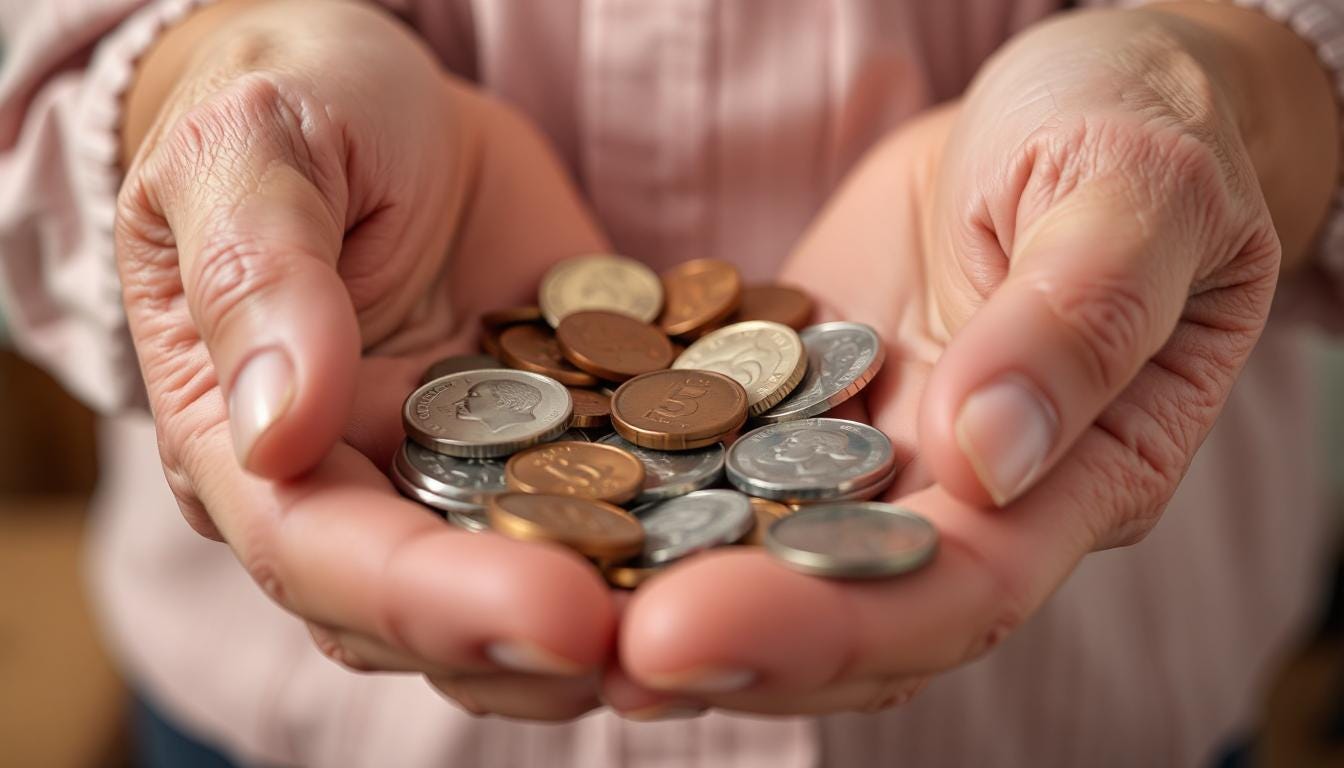
I have loose change scattered all over the house — in bowls, bottles, and drawers. Nobody uses coins anymore except us old duffers.
The U.S. has already stopped making pennies. Nickels and dimes can’t be far behind. Paper money feels like a relic. Hand a twenty to the kid at a drive-thru and you’ll get the same look you’d get if you handed him a rotary phone.
I’m not nostalgic for cash. But I am uneasy about losing it.
Cash has substance. It’s ownership you can feel. A few bills in your pocket make you feel grounded in a way an ATM never will. Cards work, apps work, tap-to-pay works — but none of them give that quiet reassurance of holding actual money.
We’re already living in an increasingly cashless world.
Tap to buy groceries. Venmo for splitting lunch. Zelle for the kid mowing the lawn. Even peaches at the farmers’ market now require a QR code.
It’s efficient. It’s fast. And it’s not all bad.
A cashless system means fewer robberies, less tax dodging, faster transactions, and no more ATM scavenger hunts. Money moves instantly and traceably.
Digital money could help people long excluded from traditional banking — but only if the system is built to welcome them.
It could make business easier for everyone from gig workers to taco trucks.
In theory, digital money could make the system fairer.
The Downside
Progress always has a shadow. And the shadow here is simple:
When everything is digital, whoever controls the system controls everything.
Governments, banks, corporations — or some tangled alliance of all three — won’t just manage the economy. They’ll manage access to it.
You want food? Heat? A car? A prescription?
You won’t just need money. You’ll need permission.
That’s what concerns me. Not because I expect villains to seize control, but because history shows how easily small rules become big ones when good intentions mix with power, fear, or “just one more safeguard.”
And then there’s the real nightmare scenario:
What happens when the power goes out?
Not a flicker during a storm — I mean grid-down: cyberattack, solar flare, sabotage. Our tap-to-pay world — and all your personal wealth — vanishes instantly.
No banking.
No fuel pumps.
No supply chain.
No way to buy food even while the stores are still stocked because they’ll be closed when all goes dark.
Governments are trying to prepare for an economic catastrophe, but “trying” and “ready” are two very different things.
(See “governments.”)
The Privacy Problem
Then there’s the quiet but rapid erosion of privacy. Every digital transaction is a breadcrumb in a trail that leads straight through your life — what you read, what you eat, what you believe. I’ve always shrugged this off. Who cares about me? I’m a tiny fish.
Until laws change.
Or norms change.
Or someone decides tiny fish matter after all. Big fish eat them.
So What Do We Do?
We can’t stop the shift. The cashless world is already here. But we can talk about what scares us, ask our leaders questions, and be honest about what we’re giving up in exchange for convenience.
And maybe should use cash once in a while as long as it’s around.
Not because it’ll change the world, but because it reminds us that the world used to be something we could hold in our hands and hide in cookie jars.
Meanwhile, keep your eyes peeled for the first busker with a portable card reader. That’ll be the moment we know cash isn’t just dying — it’s gone.

Great read and all true.
Hello, Dave! I have to say, you really nailed the contradictions of this new cashless world we’re living in. Sure, it’s convenient, and in theory, it should make things easier for more people—but it also leaves us pretty exposed if the system ever falters, or if those in charge start changing the rules on us. Your point about privacy is spot on. Sometimes I shrug it off too, but you never know when “nobody cares what I’m doing” suddenly turns into “wait, everyone can see everything.”
What really stuck with me was your thought about using cash not as some grand protest, but as a way to stay grounded and pay attention to what’s changing. There’s something oddly comforting about having a few coins or bills in your pocket, even if it feels a little old-fashioned these days. Thanks for sharing your perspective; it made me want to notice those little tangible things a bit more, before they quietly slip away.